
Safe use
What not to plug into a power strip, and when to replace one
Twelve outlets invite twelve plugs, but a power strip shares one wall outlet's worth of power. Here is what the safety agencies say belongs on a strip, what goes straight into the wall, and the signs that a strip has had its day.
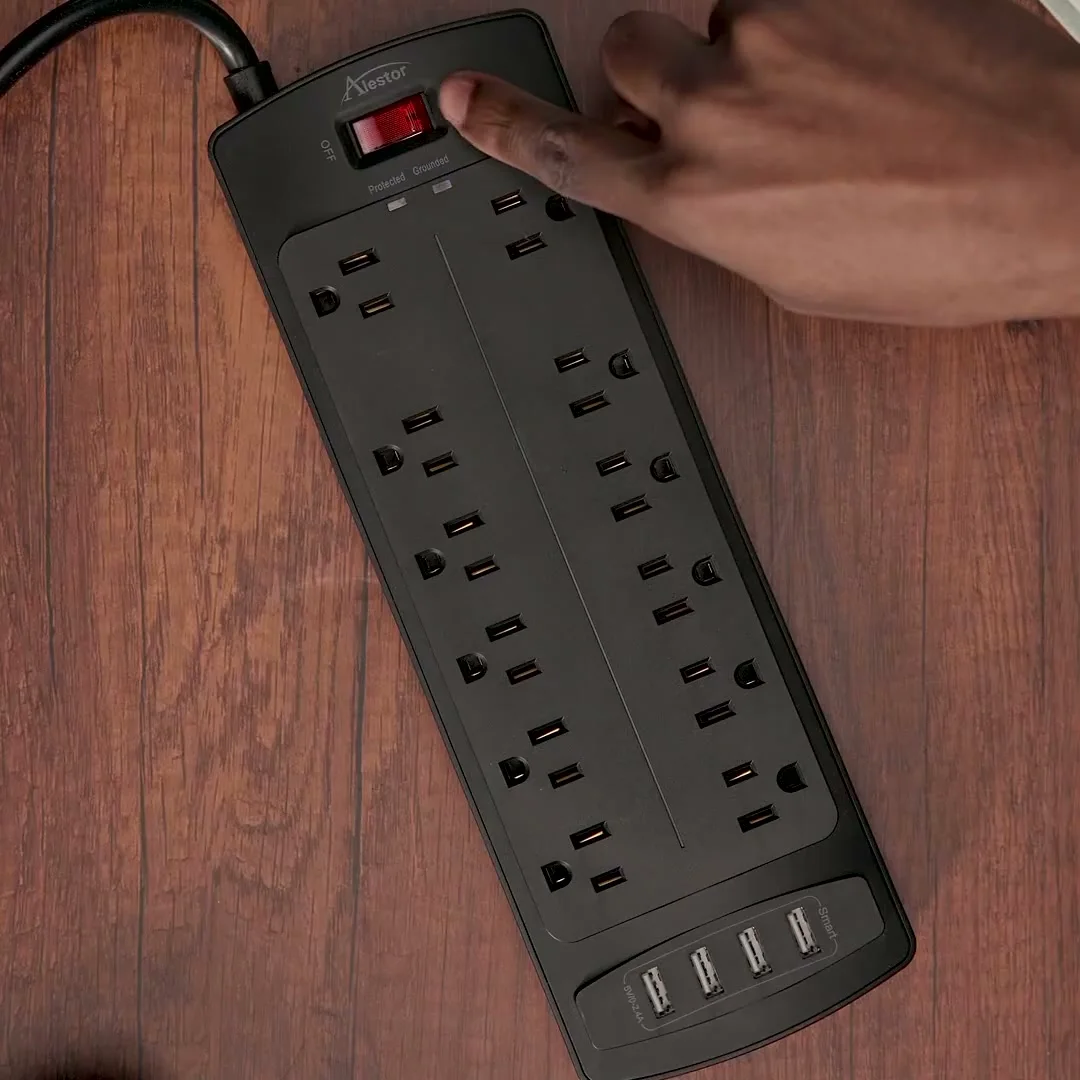
What a power strip is built for
OSHA, in its interpretation on power strips at work, gives the shortest answer: power strips are designed for several low-powered loads, such as computers, peripherals and audio and video equipment. That is the desk, the TV wall and the bedside table. Many small things at once, none of them hungry.
The number of outlets is not the limit. The load is. UL Solutions puts it simply: just because a strip has eight outlets does not mean you can or should plug in eight things. The Alestor strip has twelve outlets and four USB ports, and the whole lot is rated for 1,875 watts, which is 15 amps at 125 volts.
ESFI adds the point most people miss. A strip does not add power to a location. It gives more access to the same limited capacity of the circuit it plugs into. Twelve sockets on the wall end of a 15 amp circuit are still a 15 amp circuit.
Space heaters go into the wall, every time
This is the one item all the sources agree on without exception. The U.S. Consumer Product Safety Commission, in its winter safety release of January 2026, says to plug electric space heaters directly into a wall outlet, never into an extension cord or a power strip. CPSC counts an average of 1,600 fires a year involving portable heaters in 2020 to 2022.
OSHA names space heaters first among the high power loads a strip is not designed for, and ESFI tells you not to use an extension cord or a power strip with heaters or fans, because the cords can overheat. A heater can use most of the strip's rating by itself, and it runs for hours at a time.
Major appliances skip the strip too
The same rule covers the big appliances in a home. OSHA lists refrigerators and microwave ovens with space heaters as loads that can easily exceed the ratings of many power strips. The NFPA says major appliances, refrigerators, dryers, washers and stoves, should be plugged directly into a wall receptacle outlet, and that extension cords and plug strips should not be used. The U.S. Fire Administration gives the same list and the same advice.
NFPA adds a rule for the wall outlet itself: run only one heat-producing appliance from an outlet at a time. A coffee maker, a toaster and a kettle on one outlet, with or without a strip in between, is exactly the overload these sources warn about.
| Appliance | Where it plugs in | Who says so |
|---|---|---|
| Space heater | Directly into a wall outlet | CPSC, OSHA, ESFI |
| Refrigerator, freezer | Directly into a wall outlet | OSHA, NFPA, USFA |
| Microwave oven | Directly into a wall outlet | OSHA |
| Washer, dryer, stove | Directly into a wall outlet | NFPA, USFA |
| Fan | Not on a power strip or extension cord | ESFI |
| Computer, monitor, printer | A power strip is designed for these | OSHA |
| TV, audio and video equipment | A power strip is designed for these | OSHA |
All sources are listed with links at the end of the guide.
Small loads still add up
Even without a heater, a busy strip can carry more than it looks. A gaming computer, two monitors, a console, a soundbar and a lamp are each modest, but they all draw at once. UL Solutions advises checking the electrical rating of the strip, in watts or amps, and knowing what you are going to plug in, so you do not draw more current than it is designed for.
The number is printed on each device, on the power supply or on the label near the plug. Add them up and compare the total with the 1,875 watts the Alestor strip is rated for. Chargers draw little. Anything that heats, from a hair dryer to a kettle, draws a lot. If the total comes close to the rating, split the load between two wall outlets on different walls, rather than adding a second strip to the same one.
The kitchen counter is a special case
Countertop appliances that heat, kettles, toasters, coffee makers and air fryers, are the loads a power strip is not made for. NFPA asks you to run only one heat-producing appliance from a wall outlet at a time, and OSHA names the microwave among the loads that can exceed the ratings of many strips. On a counter, give each of them its own wall outlet and use them one after another.
No strip into a strip, no strip into a cord
Daisy-chaining is plugging one power strip into another to get more outlets, or into an extension cord to get more reach. Every source rules it out. OSHA says listed power strips are to be plugged directly into a permanently installed wall receptacle, and are not to be connected to other strips or to extension cords. ESFI says multiple-outlet strips must go into mounted receptacles and cannot be chained together.
The NFPA Fire Code is just as direct: power taps that are plugged into other power taps should be removed, because that arrangement is prohibited, and a strip should not be connected to an extension cord to extend its reach.
The practical fix is to pick the right length to begin with. If the outlet is twenty feet away, a 20 ft strip reaches it on its own. If you are short of outlets, twelve on one strip usually cover what two chained strips were doing. Our cord length guide helps with the measuring.
What the overload switch is for
The U.S. Fire Administration advises two things about strips: do not overload them, and use strips that have internal overload protection. On the Alestor strip that is the lit switch at the head. It turns all twelve outlets on and off, and it trips when the load passes 15 amps.
If it trips, do not just switch it back on and carry on. Unplug whatever pushed it over, which is nearly always something with a heating element, and move that to a wall outlet. If the strip trips again with only ordinary loads on it, stop using it.
When to replace a power strip
UL Solutions makes a point that surprises people: strips and surge protectors do not expire or need replacing after a set time. What retires a strip is its condition and, for a surge protector, its protection light.
- The cord or plug is cracked, frayed or worn. CPSC and USFA both say to replace worn or damaged cords right away.
- The cord, plug or strip gets hot with ordinary loads. CPSC treats a hot cord as a sign of overload or a fault.
- The housing is cracked or damaged. UL Solutions says to throw out a strip that is damaged, frayed or brittle and get a new one.
- On a surge protector, the protection light is out while the strip is switched on. ESFI advises protectors with exactly that kind of light, so you know when to replace them.
- The strip has no mark from a testing laboratory. CPSC advises looking for that label on the package and on the product.
On the Alestor strip the Protected light at the head stays lit while the surge circuit is working. If it is out while the switch is on, the surge protection is not working, and the strip should be replaced. Our guide on what 2,700 joules means explains the rest of the label.
A setup the agencies would recognize
Put together, the sources describe one sensible arrangement. The strip plugs straight into a wall outlet, on a cord long enough to reach without help. Its cord runs along the wall, never under a rug or a door. It carries computers, screens, chargers, lamps and audio, and nothing that heats. The heater, the fridge and the microwave each have a wall outlet of their own. Phones and watches charge from the USB ports, so their adapters never take an outlet at all.
None of this replaces the instructions that come with the strip, your local electrical code or a licensed electrician. If you find yourself needing a strip in every room, ESFI's point stands: that usually means the house needs more outlets, not more strips.
Wondering whether one particular appliance belongs on the strip? Write to outlets@myalestor.com, and the Alestor support desk tells you whether we would plug it in or keep it on the wall.
