
Cord length
How long a power strip cord you need, and how to run it safely
A strip that does not reach ends up on a second extension cord, and a cord run the wrong way ends up under a rug. Here is how to measure for the right length and where the safety agencies say the cord may and may not go.
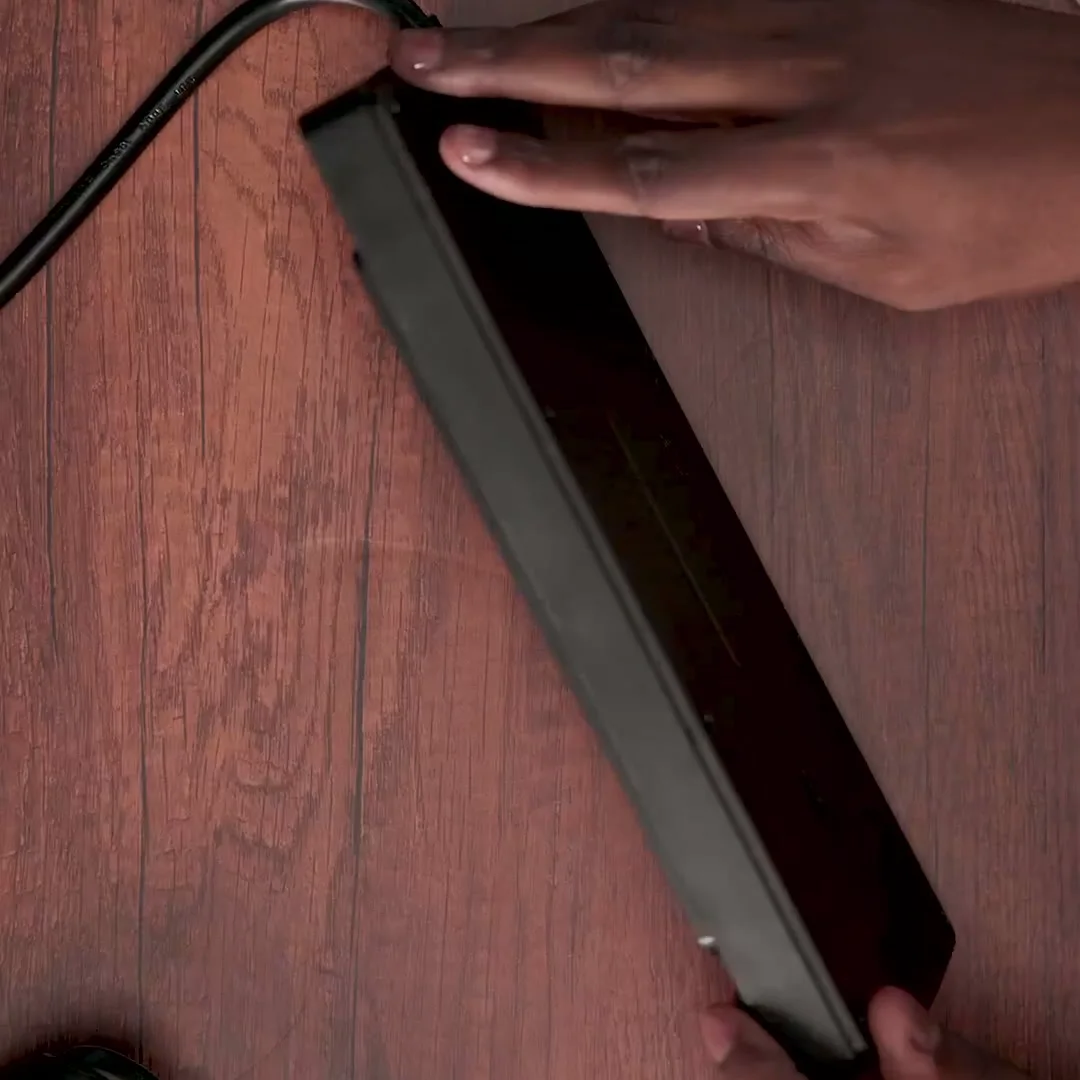
Measure the route, not the room
The usual mistake is measuring the straight line from the outlet to the desk. A cord never takes the straight line. It drops from the outlet to the floor, follows the baseboard, turns the corner of the desk and climbs to wherever the strip will sit. Every one of those turns adds length.
Take a tape measure, or a piece of string, and lay it along the actual route: down from the outlet, along the wall, behind the furniture, up to the spot where you want the outlets. Then add a foot or two. A cord that only just reaches pulls on the plug every time someone moves the desk, and a plug half out of the outlet is not where you want twelve devices.
If your number falls between two cord lengths, take the longer one. The spare length tucks away behind the furniture. A cord that is too short has only one fix, a second extension cord, and that is the one fix all the agencies rule out.
Which length suits which room
The Alestor strip comes with four cords on the same twelve-outlet body. These are the rooms each length is made for, as a starting point for your own measurement.
| Cord | Where it usually fits | Finishes |
|---|---|---|
| 6 ft | A desk, nightstand or TV stand against the wall, with the outlet behind or beside it | Black, white, gray |
| 10 ft | A bed or sofa a few steps from the wall, a desk that faces into the room | Black, white, gray |
| 15 ft | A long wall of shelves or an entertainment wall with the outlet at one end | Black |
| 20 ft | A workbench, craft table or desk across the room from the only outlet | Black, white |
Finishes as of our last catalog update. The strip itself is the same on every length.
Each length has its own page: the 6 ft strip, the 10 ft strip, the 15 ft strip and the 20 ft strip.
Plan the plugs before you pick the length
Before you settle on a cord, list what will plug in and where it sits. A desk with a computer, two monitors, speakers and a lamp needs the strip under or behind the desk. A bedroom with a lamp and a charger on each side needs the strip behind the headboard, roughly in the middle. The strip goes where the plugs are, and the cord does the travelling.
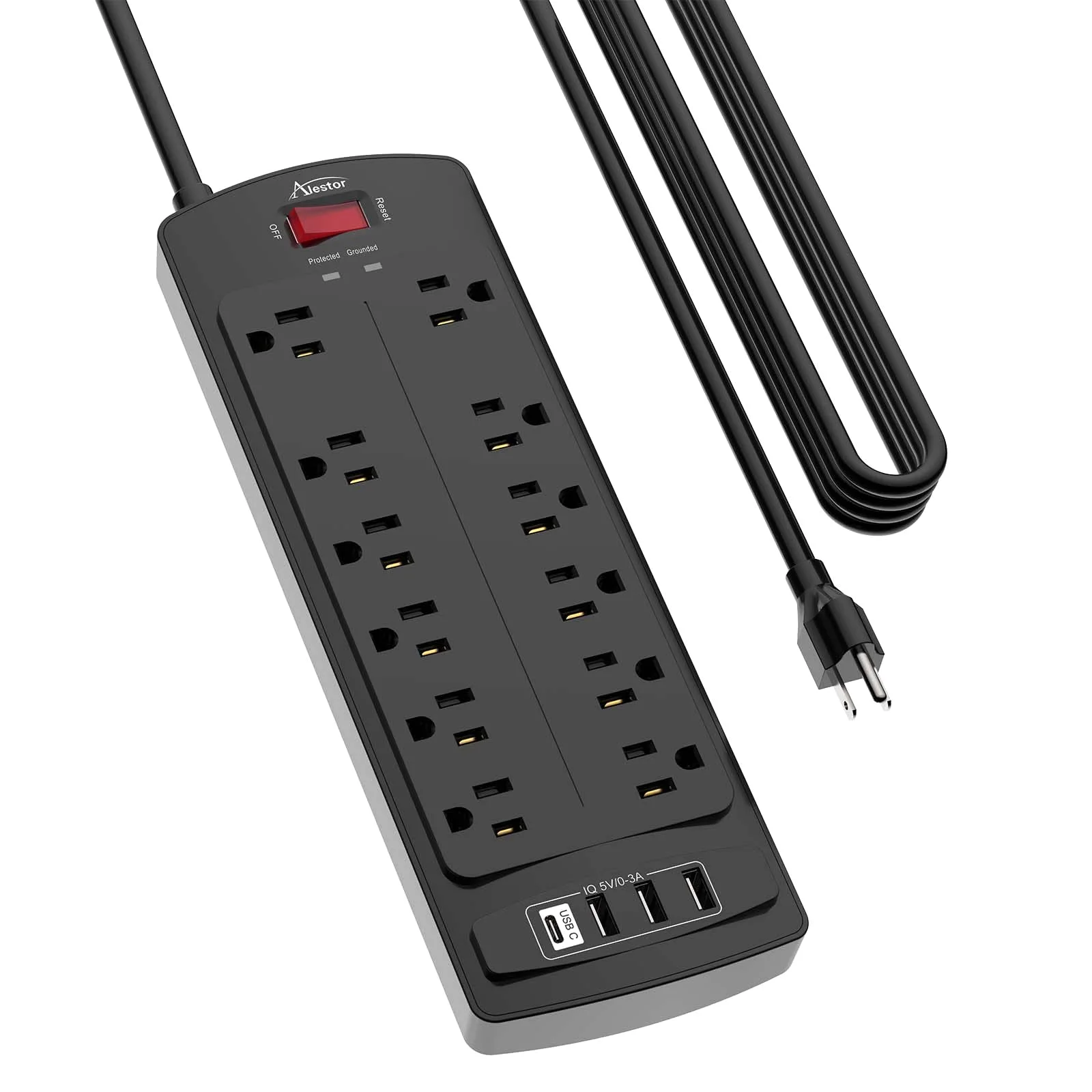
Then look at the plugs themselves. Laptop bricks and router supplies are wide, so put them on the two outlets at the top of the Alestor strip, which are spaced 2 inches apart for that reason. Phones, earbuds and watches can skip their own adapters entirely and use the USB ports, which frees outlets for the things that need them.
With the strip placed by the plugs, measure from there to the wall outlet. That number, plus slack, is your cord length.
Never under a rug or a piece of furniture
This is the rule every source repeats. The CPSC home electrical safety checklist explains why: furniture or a rug resting on a cord can crush the insulation or break the wire strands inside. A covered cord also cannot shed the heat it makes, and UL Solutions calls throwing a rug over a cord one of the worst things you can do.
The CPSC fact sheet on extension cords puts it in one line: do not run cords under carpets, through doorways or under furniture. The U.S. Fire Administration gives the same advice, to avoid putting cords where they can be damaged or pinched, like under a carpet or a rug.
In practice, that means the cord goes around furniture, not under its feet, and along the wall behind a rug rather than across the floor beneath it. If the only route to the outlet runs under a rug, the strip belongs on the other side of the room, or the room needs an outlet nearer to it.
Keep it out of doorways and walkways
A cord across a doorway gets stepped on, rolled over and caught by the door. CPSC lists cords in the path of foot traffic as a tripping hazard that also damages the cord. The NFPA Fire Code goes further for power strips in particular: the cord of a power tap shall not run through walls, ceilings or floors, under doors or under floor coverings.
ESFI's advice on extension cords says the same, and adds one more: do not run a cord through a wall, a doorway, a ceiling or a floor to reach the next room. The cord of a strip is made to lie in the open, along a wall, where you can see it.
No staples, no nails, no tight coils
It is tempting to tidy a long cord by stapling it along the baseboard. The CPSC checklist explains why not: nails and staples can tear or crush the insulation or cut the wires inside, which is a fire and shock hazard. ESFI says the same in four words: do not nail or staple.
For the spare length, CPSC has a specific warning about cords that are tightly wrapped around an object. Wrapped cords trap heat that would otherwise escape, and that can melt or weaken the insulation. So if there is slack, gather it in a loose loop with the hook-and-loop tie that comes on the Alestor cord, and do not wind it tightly around a chair leg or the strip itself.
For the strip, the two keyhole slots on the back let you hang it from two screws under a desk or on the side of a bench. That keeps the outlets off the floor, out of the vacuum's path, and the cord in a single run to the wall. The product page has the size of the housing.
Where the strip itself should sit
A strip on the floor collects dust, gets kicked and sits in the path of the vacuum. Off the floor is better: hung under the desktop, screwed to the back of a TV stand, or mounted on the wall behind a bench. The outlets stay where you can reach them, and the lights at the head of the strip stay where you can see them.
Leave the strip and the equipment around it some air. The CPSC checklist reminds you that entertainment equipment needs to breathe and should not be shut in a cabinet without openings, and the same sense applies to a strip with a dozen chargers on it. Do not bury it under a pile of cables or a heap of laundry.
A hot cord is a warning
Once everything is plugged in, touch the cord along its length after it has been working for a while. The CPSC extension cord sheet says that if any part of the cord is hot while in use, it may be overloaded, and that overheating can happen at the plug, at the socket or along the whole cord. The checklist adds that a warm cord, plug or outlet is a sign to look at what is plugged in.
On a strip, overload usually means something with a heating element: a space heater, a hair dryer, a kettle. Those belong in a wall outlet, and our guide on what not to plug into a power strip lists them. A cord that stays hot with ordinary loads, or that is cracked or frayed, should be replaced.
Strips are for reaching an outlet, not replacing one
The last point is about time rather than distance. The NFPA Fire Code describes power taps as being for temporary use, not as a replacement for permanently installed receptacles. ESFI says that heavy reliance on extension cords is a sign of too few outlets.
A 20 ft strip that has run across the same room for years is doing the job of wiring. It works, but an electrician can add an outlet where you need it, and then the strip goes back to being a strip. Until then, the Alestor strip on the right length, run along the wall and plugged straight into the outlet, is the setup the agencies describe.
- Measure the real route and add a foot or two of slack.
- Between two lengths, take the longer cord.
- Run the cord along the wall, never under a rug, a door or furniture.
- No staples or nails, and no tight coils of spare cord.
- Plug the strip straight into a wall outlet.
- A hot or damaged cord means unplug and look again.
Not sure which length reaches your outlet? Write to outlets@myalestor.com, and the Alestor support desk answers with the cord we would pick for your room.
